
Recent Publications

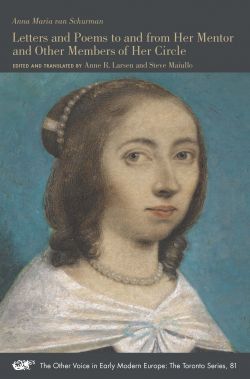
Anna Maria van Schurman, Letters and Poems (ed. & trans. by Anne R. Larsen and Steve Maiullo)

Anna Maria van Schurman, Letters and Poems to and from Her Mentor and Other Members of Her Circle, ed. & trans. by Anne R. Larsen and Steve Maiullo, Iter Press, "The Other Voice in Early Modern Europe: The Toronto Series 81", 2022.

Winner of the 2021 Society for the Study of Early Modern Women and Gender's Award for a Scholarly Edition in Translation

Anna Maria van Schurman was widely regarded as the most erudite woman in seventeenth-century Europe. As “the Star of Utrecht,” she was active in a network of learning that included the most renowned scholars of her time. Known for her extensive learning and her defense of the education of women, she was the first woman to sit in on lectures at a university in the Netherlands and to advocate that women be admitted into universities. She was proficient in fourteen languages, including Latin, Greek, Hebrew, Arabic, Syriac, Aramaic, Persian, Samaritan, and Ethiopian, as well as several vernacular European languages. This volume presents in translation a remarkable collection of her letters and poems—many of which were previously unpublished—that span almost four decades of her life, from 1631 to 1669.

“This volume of letters and poems, which comes at a propitious time in Anna Maria van Schurman scholarship, is far more inclusive than anything I have seen, and will interest a potentially large audience of knowledgeable readers. The letters included here, in superior translations, display the art of letter writing in all its facets and possibilities, trace the continued exchange of ideas with members of van Schurman’s circle, and exemplify the scholarly debates of the seventeenth century, with a woman as one of the debaters.”

- Cornelia Niekus Moore, University of Hawaii

ANNE R. LARSEN is professor emerita of French and senior research professor at Hope College in Holland, Michigan. She is the author of Anna Maria van Schurman, “The Star of Utrecht”: The Educational Vision and Reception of a Savante.

STEVE MAIULLO is Associate Professor of Classics at Hope College. He teaches Latin and Greek language and literature and is the author of articles on Plato and the teaching of Latin and Greek.

More info here.
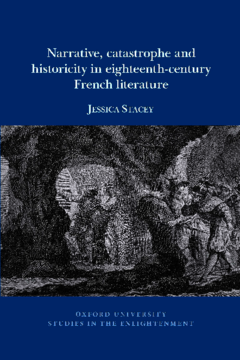
Narrative, catastrophe and historicity in eighteenth-century French literature (Jessica Stacey)

Jessica Stacey, Narrative, catastrophe and historicity in eighteenth-century French literature,

Liverpool, Liverpool University Press, coll. "Oxford University Studies in the Enlightenment", 2022.

EAN: 9781800856004

384 pages

Prix : £65.00

Date de publication : 03 Mars 2022

How do communities tell and re-tell stories of catastrophe to explain their own origins, imagine their future, and work for their survival? This book explores this question, so vital for our present moment, through narratives produced in eighteenth-century France: a tumultuous period when a “modern” national history was being elaborated.


- Brings contemporary work on the catastrophic imaginary into dialogue with philosophies of historical time and the study of eighteenth-century medievalism, offering a fresh perspective on how and why communities retell past catastrophes, and imagine future ones.

- Drawing on a wide variety of literary, historical and philosophical sources from the late seventeenth to the early nineteenth centuries, the book illuminates the pre- and remediation of catastrophes by showing how the same stories and motifs were reworked by writers over the course of the eighteenth-century.

- This book shows how French eighteenth-century writers viewed their own history as a haunting past, instantiated in the dangerous but also attractive figures which menace to crowd out the present, and return it to a catastrophic Dark Age: barbarians, usurpers, lost heirs, prophets, ghosts and martyrs. 


***


“We, too, have seen our connections and analogies come loose; a sense of the pandemic as a repetition of something from the past has ceded as the many threads of distinct future problems become clearer, just as the early ‘we’re all in this together’ narratives have unravelled. The book is a work of critique, seeking in part to expose embarrassments, narratives that go nowhere, attempts to recast contemporaries as anachronisms.”

(Read the author’s accompanying blog post)

More info here.